






来源:高分子材料科学|
发表时间:2022-12-27
点击:7999
【研究亮点】
目前,在柔性锌空气电池领域中最常使用的是聚乙烯醇基碱性电解质,然而,该电解质具有较差的电池循环稳定性和电解质保液能力。天津大学钟澄、胡文彬研究团队设计并成功制备了一种新型磺酸基纳米复合凝胶电解质材料,具有高的离子传导率、强耐碱性和良好的锌阳极稳定性,得益于(1)强阴离子型磺酸基团的存在有助于暴露更耐锌枝晶形成的Zn(002)晶面;(2)纳米凹凸棒电解质添加剂,有利于增强电解质的离子传导率、电解质吸收和保持能力。基于此,所组装的锌空气电池具有450小时的超长循环寿命,并且能够驱动多种柔性电子器件运行。
【主要内容】
如今,智能可穿戴器件开始不断被研发并进入消费市场,从而促进了柔性储能器件的发展。其中,柔性水系锌空气电池由于其具有高的理论能量密度、高安全性和环境友好性而引起了广泛的研究兴趣。准固态凝胶聚合物电解质是目前应用最为广泛的柔性电解质材料,具有高离子传导率、较好的机械柔性,且可避免传统液态电解质的漏液和挥发问题。目前,柔性锌空气电池主要使用聚乙烯醇(PVA)–KOH聚合物电解质,因为聚乙烯醇具有高的化学和电化学稳定性、低成本和简单的制造工艺。然而,该电解质的环境稳定性较差,从而导致电池循环寿命较短(10–20小时)。除此之外,具有更好亲水能力的凝胶电解质,如聚丙烯酸、聚丙烯酸钠、聚丙烯酰胺等,显示出优异的电池循环稳定性(长达200小时),但仍无法满足市场需求。为了适应锌阳极和催化剂材料领域的快速发展和显著成就,迫切需要开发具有高电极稳定性、保水性和强耐碱性的电解质材料,用于超长寿命柔性锌空气电池。
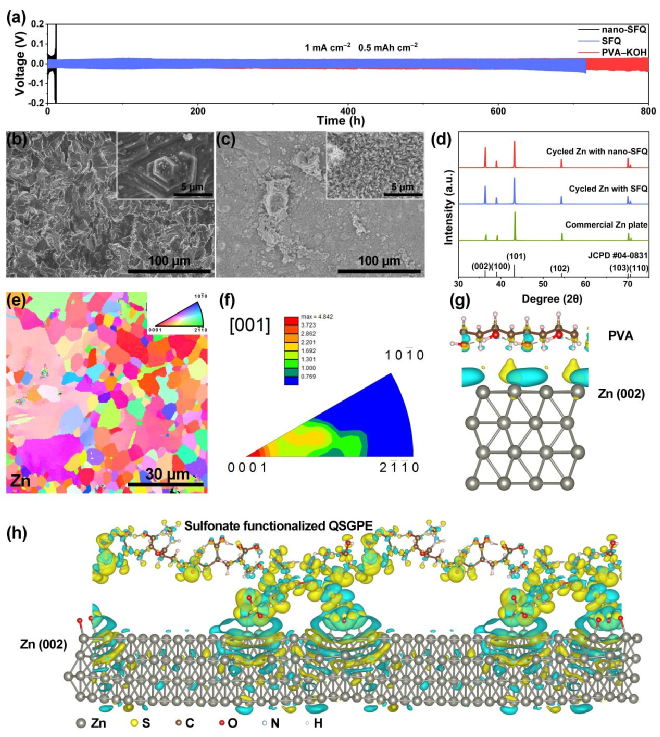
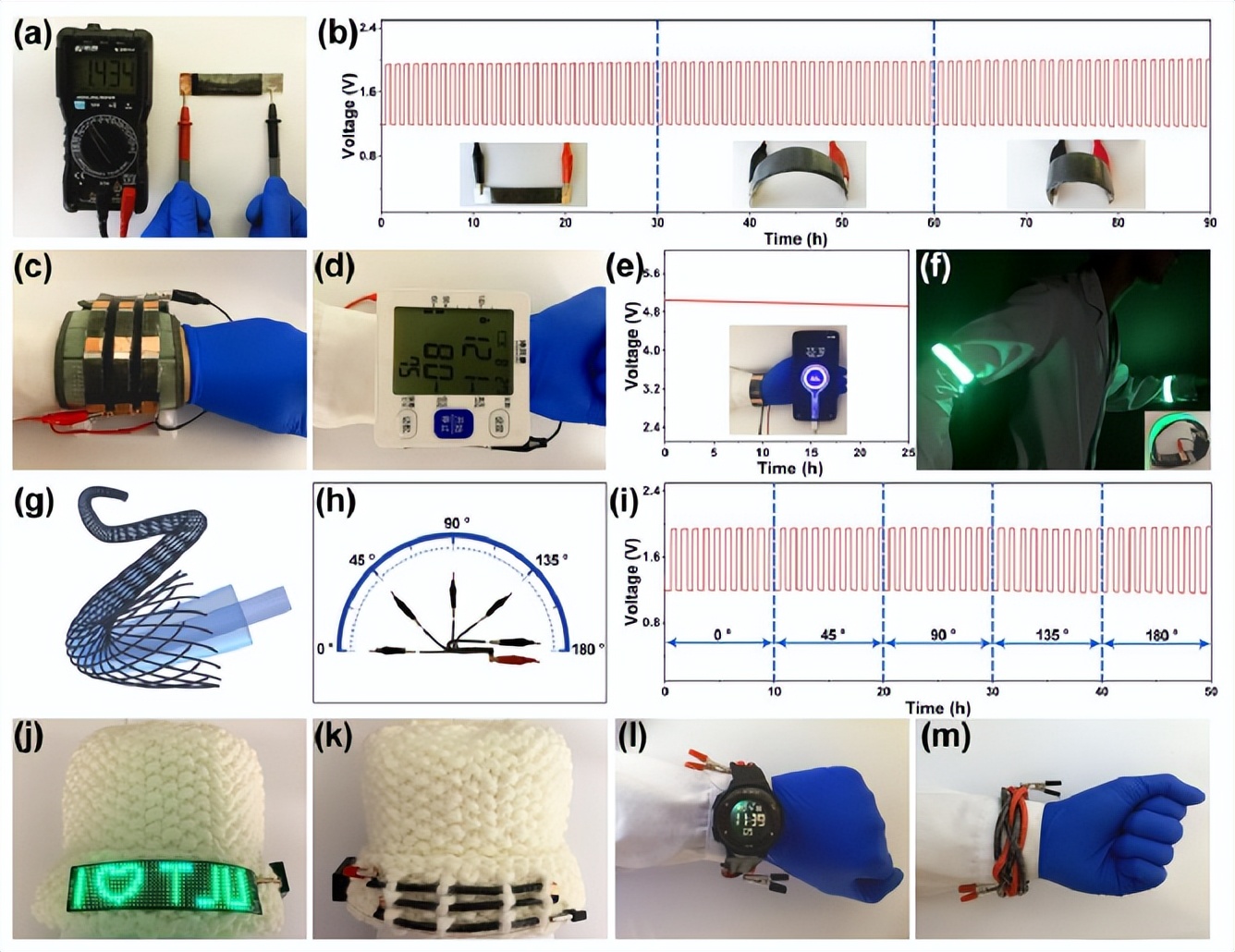
鉴于此,本研究制备了一种磺酸基纳米复合聚合物电解质,并将其应用于柔性锌空气电池中。该电解质具有高离子传导率、强耐碱性和优异的锌电极稳定性。该电解质聚合物链中富含有强阴离子型磺酸基团,有助于暴露更多的Zn(002)晶面。据报道,该晶面更能够抑制锌金属枝晶的形成。并且,纳米凹凸棒被用作聚合物电解质添加剂,以提高离子传导率、电解质吸收和保持能力。基于上述多种因素协同效应,制备所得纳米复合聚合物电解质显示出186 mS cm−1的高离子传导率,约850 wt.%的高电解质吸收率和电解质保持能力(一周后可保持其重量的>90 wt.%)。基于该电解质所组装的锌空气电池表现出450小时的超长循环寿命。此外,多个层状或者电缆结构的柔性锌空气电池的串并联单元所组装的能量带或线,可以集成到多种电子设备中(如血压计、夜跑臂带、柔性屏幕、手表等),在可穿戴领域中显示出广泛的应用前景。
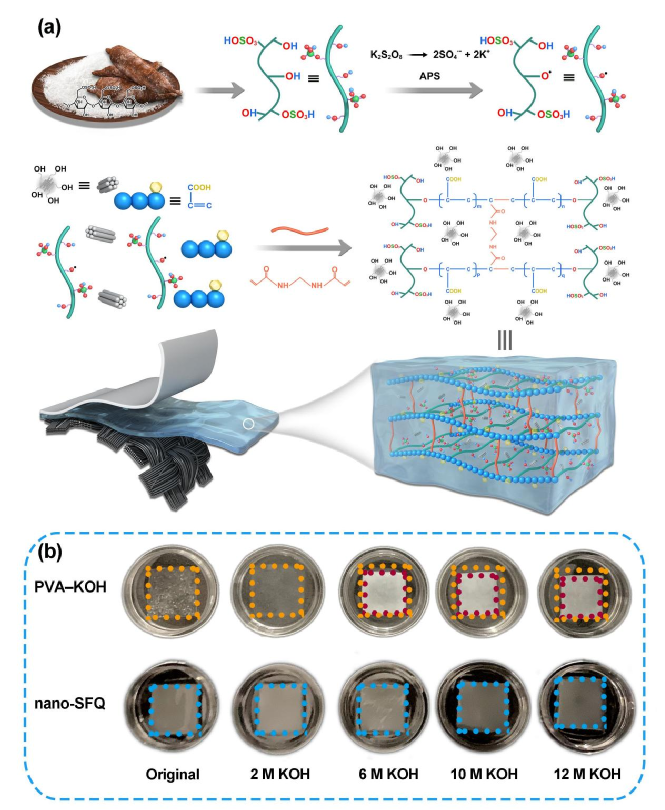
Figure 1. (a) Schematic diagram of the synthesis process of the nano-SFQ. (b) The photos of PVA–KOH and nano-SFQ in the original state and immersed in KOH solutions of different concentrations.
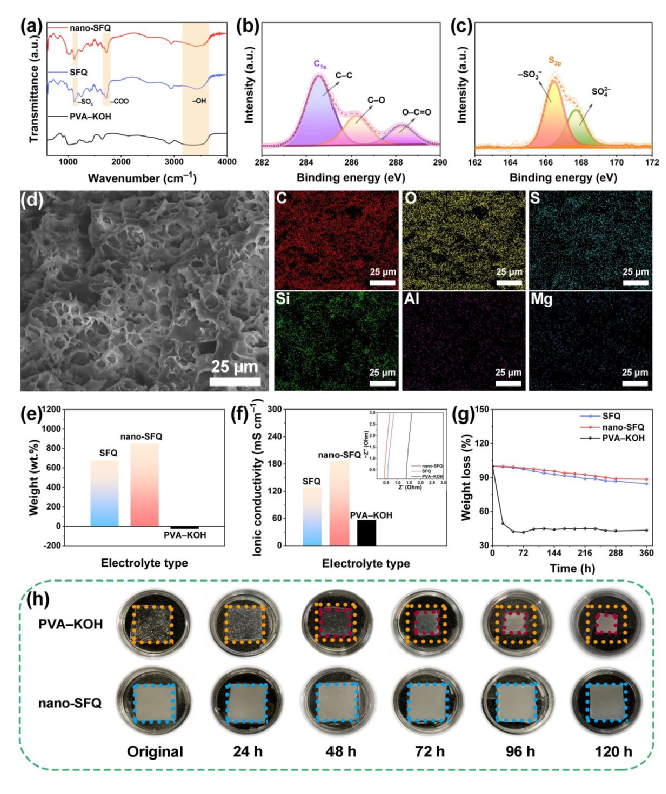
Figure 2. (a) FTIR patterns of the nano-SFQ, SFQ and PVA–KOH. High-resolution XPS spectrum of (b) C 1s and (c) S 2p of nano-SFQ. (d) FESEM image and EDX element mapping results of nano-SFQ. (e) Electrolyte uptake behaviors, (f) Ionic conductivities and (g) Electrolyte retention capabilities of PVA–KOH, SFQ, and nano-SFQ. (h) The photos of PVA–KOH and nano-SFQ in the original state and after exposure to air for different period of time.
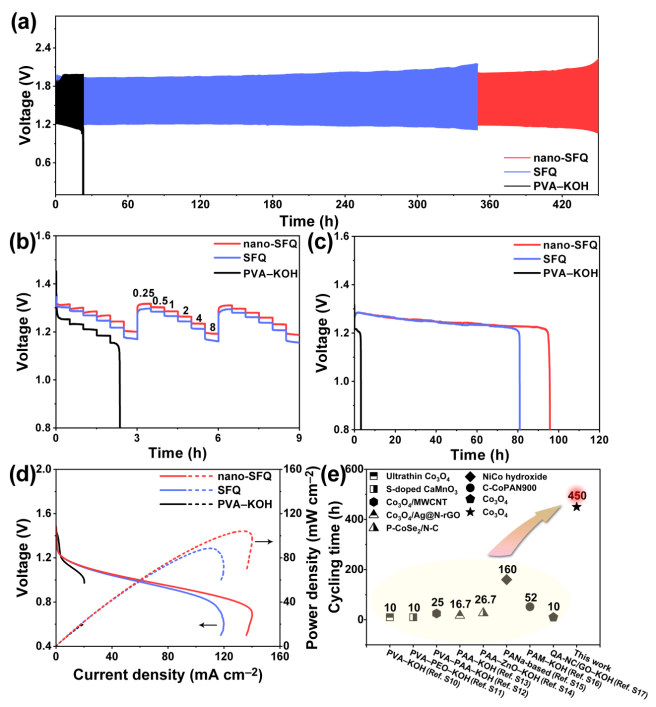
Figure 3. Electrochemical performances of the FAZAB based on nano-SFQ, SFQ and PVA–KOH QSGPE. (a) Galvanostatic discharge–charge cycling curves at 1 mA cm–2 with a duration of 1 h per cycle. (b) Rate profiles at different current densities of 0.25, 0.5, 1, 2, 4, and 8 mA cm–2. (c) The galvanostatic discharging curves. (d) Polarization and corresponding power density curves. (e) Comparison of the cycling life of the nano-SFQ-based FAZAB with previously reported FAZABs.
Figure 4.(a) Galvanostatic zinc plating–stripping at 1 mA cm–2with 0.5 mAh cm–2in Zn–Zn symmetrical batteries based on nano-SFQ, SFQ and PVA–KOH QSGPE. FESEM images of the cycled zinc anode using (b) nano-SFQ and (c) PVA–KOH QSGPEs. (d) XRD results of the cycled zinc anodes using the sulfonate functionalized QSGPEs and commercial zinc plate. EBSD result of the cycled zinc anode using nano-SFQ in terms of (e) orientation mapping, and (f) inverse pole figure. Mechanistic analysis of the interface between the zinc anode (grey balls) and (g) PVA–KOH and (h) sulfonate functionalized QSGPE.
Figure 5.(a) Open circuit potential profile of the FAZAB. (b) Galvanostatic discharge–charge cycling curves of the FAZAB under different bending states. Photos of connected FAZABs powering (c–d) a wristband blood pressure monitor, (e) telephone and the galvanostatic discharging curve of connected battery series, (f) flexible light strip armband. (g) Schematic illustration of the configuration of the wire-type FAZAB. (h) Photos of the wire-type FAZAB under various bending angles with corresponding (i) galvanostatic discharge–charge cycling curves. Photos of knittable FAZABs powering (j–k) a wearable flexible light emitting diode screen, and (l–m) a wristwatch.
封面来源:图虫创意

“本文由新材料在线®平台入驻媒体号「高分子材料科学」微信公众号提供,观点仅代表作者本人,不代表本网站及新材料在线®立场,本站不对文章内容真实性、准确性等负责,尤其不对文中产品有关功能性、效果等提供担保。本站提醒读者,文章仅供学习参考,不构成任何投资及应用建议。如需转载,请联系原作者。如涉及作品内容、版权和其它问题,请与我们联系,我们将在第一时间处理!本站拥有对此声明的最终解释权。”